
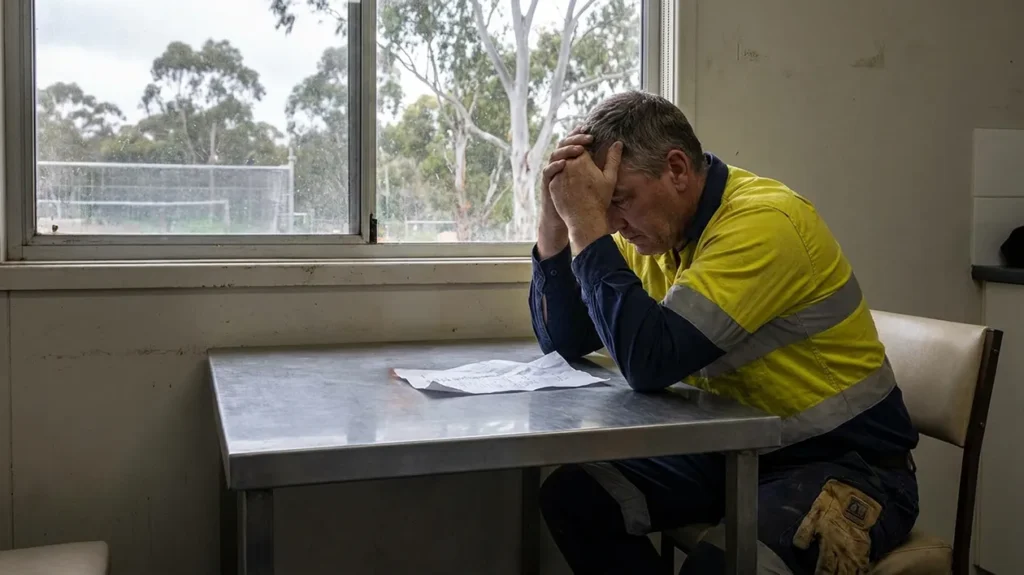
A demotion happens when your employer cuts your duties, responsibilities, seniority or pay. Under the Fair Work Act 2009 (Cth), a demotion involving a significant reduction in your remuneration or duties may amount to a dismissal, even though you are still turning up to work. Whether it does depends heavily on one thing most people never check, whether your employment contract, award or enterprise agreement expressly permits the demotion. If it does not, and the cut is significant, you may have grounds to challenge it, and you have 21 days from the date the demotion takes effect to lodge an unfair dismissal application with the Fair Work Commission.
If you have just been handed a demotion letter, do not sign anything yet. Work through the assessment below first.
Is Your Demotion Actually a Dismissal? (The 5-Point Test)
If your pay or seniority was cut without your agreement, and your contract does not allow it, you may have been dismissed in the eyes of the law, even though you are still employed. If your contract or enterprise agreement does allow it, the picture changes significantly.
Section 386(2)(c) of the Fair Work Act says a demotion is not a dismissal where two things are both true, the demotion does not involve a significant reduction in your remuneration or duties, and you remain employed by the same employer. But as the case law below shows, that is not the end of the analysis.
The Fair Work Demotion Assessment Checklist
Answer each question honestly. Write your answers down, because they will form the spine of any claim.
1. Did your remuneration decrease significantly?
Look at total remuneration, not just base salary. Loss of a car allowance, an on-call loading, a shift penalty, a bonus entitlement or a higher duties allowance all count.
There is no fixed percentage in the Act, but the case law gives a benchmark. In Harrison v FLSmidth Pty Ltd [2018] FWC 6695, a Service Supervisor was demoted to Mechanical Service Technician. The pay cut was 9.3%. It flowed through to his overtime and his super. He also lost supervision of about eight technicians and went back on the tools. The Fair Work Commission found this was a significant reduction in both his remuneration and his duties, and that he had been dismissed under section 386, even though he was still turning up to work.
2. Did your core duties substantially reduce?
Not “slightly different”, but genuinely reduced. Direct reports removed. Budget or sign-off authority stripped. Client portfolio reassigned. Decision-making handed to someone else.
3. Does your employment contract, award or enterprise agreement expressly permit the employer to demote you?
This is the question most people skip, and it is often the one that decides the outcome. Open your contract and read the variation clause. If you are covered by an enterprise agreement, read its disciplinary provisions. See the section below on NSW Trains v James for why this matters so much.
4. Was procedural fairness followed?
Were you told what the concerns were? Were you given a chance to respond? Were you allowed a support person in the meeting? Were warnings given and an opportunity to improve provided?
If you were simply told that you were being demoted without any notice, process or other action prior to this or they simply decreased your pay.
5. Have you served the minimum employment period?
Six months for most employers, twelve months if your employer is a small business (fewer than 15 employees). Below that threshold, unfair dismissal is generally not available to you, though other options may still be.
How to Read Your Answers
| Your pattern | What it usually means |
|---|---|
| YES to Q1 or Q2, NO to Q3, NO to Q4, YES to Q5 | Strong indicators of an unfair dismissal. Act quickly, the 21-day clock is running. |
| YES to Q1 or Q2, YES to Q3 (an instrument permits the demotion) | Harder. If the instrument permits it, an unfair dismissal claim may not be available. Get the wording checked. |
| NO to Q1 and Q2 (title change only, same pay and duties) | Unlikely to be a dismissal. Other avenues may still apply. |
| Demotion followed a complaint, a workplace right, an injury, pregnancy or a protected attribute | This may be adverse action, a separate and often stronger claim that does not depend on whether you were dismissed. See below. |
Action: Do not sign a new contract or an acknowledgement of the new terms. Signing can be treated as acceptance, and acceptance can end your right to argue the change was imposed on you. Move to the next section.
What Should I Do If I Get Demoted? The 72-Hour Response Protocol
Do not quit in anger. Do not sign anything accepting the new terms. Document the change, tell your employer in writing that you are continuing to work under protest, and get advice before the 21 days runs out.
Working under protest is the single most important step, and almost nobody does it. It lets you keep earning while preserving your position that you never accepted the change. As the case law below explains, an employee who says nothing can be treated as having accepted the demotion.
Step 1: Ask for the reasons in writing (within 24 hours)
A short, neutral request. You are not arguing yet, you are building a record.
“Hi [Manager], could you please confirm in writing the reasons for the change to my role and remuneration, the effective date, and the clause of my employment contract or enterprise agreement that the change is being made under? I would like to review it properly before responding.”
That last part matters. You are asking them to identify the instrument they say authorises the demotion, which is exactly the question your lawyer will need answered.
Step 2: Send the “working under protest” email (within 72 hours)
This is the script. Adapt the details, keep the substance.
Subject: Change to my role and remuneration, notice of non-consent
Dear [HR / Manager],
I acknowledge receipt of the notice dated [date] regarding the change to my role, duties and remuneration.
I do not consent to this variation of my employment contract. I have not agreed to a reduction in my duties or my remuneration, and I am not aware of any term of my contract or of any industrial instrument that permits this change to be made unilaterally.
To mitigate my financial loss, I will continue to attend work and perform the duties assigned to me under my original contract.
I would be grateful if you could provide the reasons for the change in writing, and confirm the contractual or instrument basis relied upon.
Regards,
[Name]
Send it from a personal email address as well as your work address, or BCC yourself. People lose access to work inboxes faster than they expect.
Step 3: Gather your evidence (within the first week)
- Every performance review from the last 12 to 24 months, particularly the favourable ones.
- Your signed employment contract, plus any variation letters or promotion letters.
- Any enterprise agreement or award that covers you.
- Payslips from before and after the change, showing the reduction.
- Your original position description.
- Any emails, Teams messages or notes about the meeting where the demotion was raised.
- A written file note of the meeting itself, made from memory the same day if you did not take notes at the time.
Store copies outside your work systems. Do not take confidential client material, only your own employment records.
Step 4: Get advice before day 21
The 21-day limit is strict. Extensions are only granted in exceptional circumstances, and “I was waiting to see how it played out” is not one of them.
Common Mistakes That Cost People Their Claim
- Resigning on the spot. Quitting converts your matter into a constructive dismissal argument, where you must prove you were forced out. It is a substantially harder case to run, and you have no income while you run it.
- Signing the new contract “just to keep the peace”. That is acceptance, and acceptance can be fatal to any case you have if you change your mind.
- Saying nothing at all. Silence can be treated the same way as agreement.
- Waiting for the internal grievance process to finish. Internal processes do not pause the 21-day clock.
Should You Accept, Dispute, or Resign?
Dispute if the demotion was sudden, unexplained, or cuts your pay and your contract does not authorise it. Accept (under protest, while you get advice) if it is a genuine alternative to termination for well-documented performance issues. Resign only as an absolute last resort.
| Option | Best when | The risk |
|---|---|---|
| Accept the demotion | It is a genuine alternative to termination for serious, documented performance or behaviour problems, and you want to stay | A permanent pay cut. Once accepted, the new terms become your terms. |
| Work under protest and dispute | Your pay or duties were cut suddenly, without warnings, without a clear contractual right, or in response to a complaint, an injury, or a protected attribute | The working relationship becomes strained. The 21-day deadline is unforgiving. And if an instrument does authorise the demotion, the claim may not get off the ground. |
| Resign and claim constructive dismissal | Conduct is so serious that remaining is genuinely untenable | The burden of proof sits with you and it is a high bar. No income while the matter runs. Least favourable option in most cases. |
The fastest way to work out which column you are in: did they warn you first, and does anything in writing give them the power to do this? A demotion that arrives with no warning, no performance plan and no contractual basis sits very differently from one that follows six months of documented feedback and is expressly permitted by an enterprise agreement.
On What Grounds Can an Employer Legally Demote You in Australia?
Broadly, there are three reasons an employer may reduce your role:
- Genuine restructure or redundancy of the role, where your previous position no longer exists and a lesser role is offered as redeployment.
- Serious misconduct, established through a fair process, usually including a workplace investigation.
- Documented ongoing poor performance, where clear warnings were given and a performance improvement plan was offered and failed.
Even so, the employer must act fairly. Section 387 of the Fair Work Act lists what the Commission looks at. Was there a valid reason? Were you told about it? Were you given a chance to respond? Were you allowed a support person?
Key point: A performance-based demotion is far more defensible if you were told there was a problem and given a real chance to fix it. A demotion that lands out of nowhere, with no prior warnings and no contractual basis, is much harder for an employer to justify.
The Catch: What If Your Contract or Enterprise Agreement Allows It?
This is the question most people skip, and it can be decisive.
In NSW Trains v James [2022] FWCFB 55, a five-member Full Bench of the Fair Work Commission considered a shift manager of more than 30 years who was demoted following a disciplinary investigation. His gross pay dropped from $141,442 to $127,569, a cut of roughly 9.8%. His duties did not change at all.
At first instance he won the right to have his claim heard. On appeal, he lost. The Full Bench held that the demotion was authorised by the applicable enterprise agreement and regulations, that the employer had acted within those provisions, and that there was therefore no termination of employment. His unfair dismissal application was dismissed.
The lesson is blunt. A large pay cut is not automatically a dismissal. Where an enterprise agreement, employment contract or statute expressly permits a demotion and treats it as something other than a termination, an employer who exercises that power properly is generally not exposed to an unfair dismissal claim. This is why reading your contract’s variation clause, and any enterprise agreement that covers you, is the first thing to do before you assume you have a case.
It also cuts the other way. The Full Bench confirmed that a demotion involving a significant pay cut which is not authorised in this way will ordinarily be treated as the employer tearing up your contract, which lawyers call repudiation. But the contract only ends if you accept that. An employee who says nothing is treated as having accepted the new terms. That is precisely why the working under protest email above matters so much.
Most people cannot tell from their own contract whether a demotion is authorised. The clauses are rarely written in plain terms. Enterprise agreements are worse. That is a question for a lawyer, inside the 21 days, not a guess.
When a Demotion Is Adverse Action, Not Just an Unfair Dismissal
If the demotion followed something you did or something you are, the picture changes again, and helpfully so. Under the general protections provisions, “altering your position to your prejudice” is adverse action. Importantly, this does not depend on establishing that you were dismissed, so it can remain available even where an unfair dismissal claim would fail.
A demotion that follows:
- a complaint or enquiry about your pay, hours or conditions
- a workers compensation claim or a period of sick leave
- pregnancy, parental leave, or a request for flexible work
- union membership or activity
- age, race, disability, sex, or another protected attribute
may give rise to a general protections claim. These claims carry a reverse onus: once you show the demotion happened and you had the protected reason, the employer must prove the reason had nothing to do with it. Compensation is not subject to the cap that applies in unfair dismissal matters. If the demotion amounts to a dismissal, the deadline is again 21 days.
Silent Demotions and Quiet Firing: When Nothing Official Happens
Not every demotion comes with a letter. A silent demotion is where your responsibilities are quietly hollowed out while your title and pay stay exactly the same.
Five signs it is happening to you:
- You are dropped from strategy or leadership meetings you used to attend.
- Your direct reports are reassigned, one at a time.
- Your budget or approval authority is quietly revoked.
- You are handed tasks well below your pay grade, while your former work goes to someone else.
- Communication from management drops off sharply and stays that way.
Silent demotions are harder to run as unfair dismissal claims, because remuneration usually has not changed. But they are not nothing. They can support a constructive dismissal argument, a general protections claim, or a bullying application, particularly where the pattern started after you raised something.
What to do: put it in writing. Ask for a formal review of your current duties against your position description, and ask, in a neutral tone, why the changes were made. Silence, or a defensive response, is evidence. Keep every reply.
Before You Do Anything Else
A demotion is not something you have to simply absorb. But nor is a pay cut automatically a claim. What decides most of these matters is what your contract or enterprise agreement actually says, whether you signed or agreed to anything, and whether you acted within 21 days.
Do not sign. Do not resign. Put it in writing, work under protest, and get advice quickly.
Talk to a specialist employment lawyer today. Call Fair Workplace Solutions on 1800 565 975 or book a consultation. We act for employees across Australia, and we will read your contract and tell you straight where you stand.
This article contains general information only and is not legal advice. Employment matters turn on their specific facts, and on the precise wording of the contracts and industrial instruments that apply to you. You should obtain advice about your own circumstances before taking any action, particularly given the strict 21-day time limit that applies to many Fair Work Commission claims.